
“To photograph is to hold one’s breath, when all faculties converge to capture fleeting reality.” – Henri Cartier-Bresson
Introduction
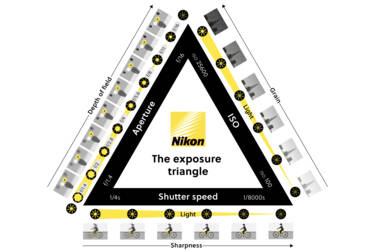
Photography is a blend of creativity and technology, both an art and a science, and at its foundation lies a delicate interplay between three core elements: aperture, shutter speed, and ISO. These components of what is commonly known as the “exposure triangle” govern how an image is exposed and ultimately determine how light, motion, and clarity are captured in a photograph. For beginners and hobbyists, a solid grasp of these principles is essential to taking control of a camera and achieving creative results with consistency.

Aperture: Controlling Light and Depth of Field
Aperture refers to the opening inside a lens that allows light to pass through to the camera sensor. It is measured in f-stops (e.g., f/2.8, f/5.6, f/11), with smaller numbers indicating a wider opening and more light entry. A wide aperture (low f-stop) not only allows more light into the camera, which is beneficial in low-light conditions, but it also creates a shallow depth of field. This is ideal for portraits, where the subject is sharply focused while the background remains blurred. Conversely, a narrow aperture (high f-stop) provides a greater depth of field, which is preferred in landscape photography to ensure that both foreground and background remain in focus.

Shutter Speed: Freezing or Blurring Motion
Shutter speed determines how long the camera’s sensor is exposed to light. It is measured in fractions of a second (such as 1/1000s) for fast exposures or in whole seconds for longer exposures. A fast shutter speed is used to freeze motion, such as capturing a bird in flight, while a slower shutter speed can create motion blur, adding a sense of movement or ethereal quality to subjects like waterfalls or traffic lights. Photographers must also consider the risk of camera shake when using slower shutter speeds, often requiring a tripod to maintain image sharpness.

ISO: Sensor Sensitivity and Image Quality
ISO defines the sensitivity of the camera’s sensor to light. Lower ISO values (100–400) are ideal for bright conditions and produce the cleanest images with minimal noise. Higher ISO values (800 and above) are helpful in darker environments but can introduce graininess or digital noise. Modern cameras have improved ISO performance dramatically, allowing for usable images at higher sensitivities, but understanding when and how to adjust ISO remains crucial for maintaining image quality.

Balancing the Exposure Triangle
Mastering photography begins with understanding how aperture, shutter speed, and ISO interact. Adjusting one element often requires compensating with another to maintain proper exposure. For instance, if a photographer narrows the aperture for greater depth of field, they may need to slow the shutter speed or increase the ISO to maintain brightness. This balancing act enables photographers to creatively and technically control their images according to lighting conditions and artistic intent.
Conclusion
The exposure triangle, aperture, shutter speed, and ISO, forms the technical backbone of photography. Learning how to manipulate these settings manually empowers photographers to move beyond automatic modes and start expressing their own visual narratives. Whether capturing a high-speed sporting event or a tranquil mountain scene at dawn, understanding these fundamentals is the first step toward crafting images with intention and confidence.

About the Author:
Michael Martin is the Vice President of Technology with Metercor Inc., a Smart Meter, IoT, and Smart City systems integrator based in Canada. He has more than 40 years of experience in systems design for applications that use broadband networks, optical fibre, wireless, and digital communications technologies. He is a business and technology consultant. He was a senior executive consultant for 15 years with IBM, where he worked in the GBS Global Center of Competency for Energy and Utilities and the GTS Global Center of Excellence for Energy and Utilities. He is a founding partner and President of MICAN Communications and before that was President of Comlink Systems Limited and Ensat Broadcast Services, Inc., both divisions of Cygnal Technologies Corporation (CYN: TSX).
Martin served on the Board of Directors for TeraGo Inc (TGO: TSX) and on the Board of Directors for Avante Logixx Inc. (XX: TSX.V). He has served as a Member, SCC ISO-IEC JTC 1/SC-41 – Internet of Things and related technologies, ISO – International Organization for Standardization, and as a member of the NIST SP 500-325 Fog Computing Conceptual Model, National Institute of Standards and Technology. He served on the Board of Governors of the University of Ontario Institute of Technology (UOIT) [now Ontario Tech University] and on the Board of Advisers of five different Colleges in Ontario – Centennial College, Humber College, George Brown College, Durham College, Ryerson Polytechnic University [now Toronto Metropolitan University]. For 16 years he served on the Board of the Society of Motion Picture and Television Engineers (SMPTE), Toronto Section.
He holds three master’s degrees, in business (MBA), communication (MA), and education (MEd). As well, he has three undergraduate diplomas and seven certifications in business, computer programming, internetworking, project management, media, photography, and communication technology. He has completed over 50 next generation MOOC (Massive Open Online Courses) continuous education in a wide variety of topics, including: Economics, Python Programming, Internet of Things, Cloud, Artificial Intelligence and Cognitive systems, Blockchain, Agile, Big Data, Design Thinking, Security, Indigenous Canada awareness, and more.